Speed Is Not Always About Moving FirstMarkets often reward companies that move quickly. But speed alone is not necessarily an advantage. A company can launch faster, hire faster and expand faster while still making the same mistakes repeatedly.
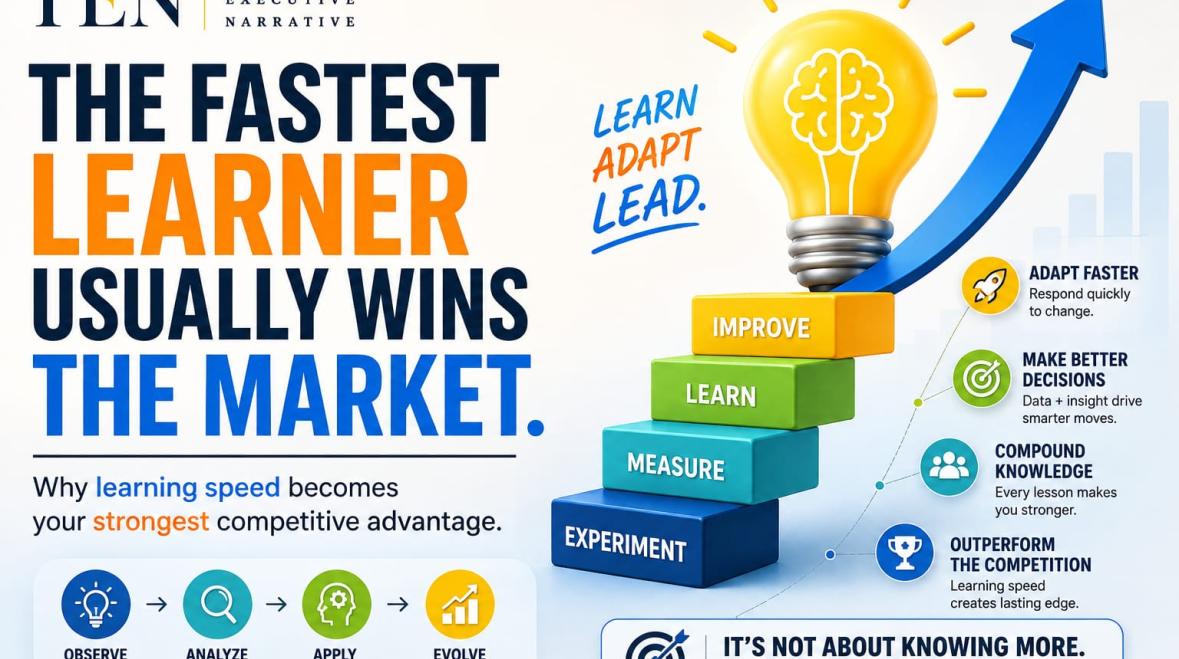
The deeper advantage is learning speed.
Organizations that learn faster can recognize what is changing, understand what is working and adjust their decisions before competitors do. They do not need to predict the market perfectly because they are constantly improving their understanding of it.
The company that learns fastest can often afford to be wrong more often than the company that moves fastest.
Every Action Creates Information
A product launch is not only an attempt to generate revenue. It is also an opportunity to learn what customers value. A failed campaign provides information about positioning. A new pricing model reveals how customers respond to different forms of value.
The difference lies in what happens afterward.
Some companies treat results as isolated outcomes. Others turn them into organizational knowledge.
When a company captures what it learns, shares it across teams and incorporates it into future decisions, individual experiences become collective intelligence. The organization becomes better at making decisions because every experiment adds to what it knows.
That creates a compounding advantage.
Learning Speed Beats Perfect Planning
No strategy survives unchanged once it meets the market.
Customer behavior is unpredictable. Competitors respond. Technologies evolve. Assumptions prove incomplete.
Trying to eliminate uncertainty before acting can therefore become expensive. By the time a company has enough information to feel completely confident, the opportunity may have changed.
Fast-learning organizations take a different approach. They make informed decisions, observe the results and adjust quickly.
The goal is not to replace strategy with experimentation.
It is to use experimentation to improve strategy faster.
The Problem With Repeating Mistakes
Organizations do not automatically become smarter with experience.
Experience only creates an advantage when it produces learning.
A company can run the same type of project repeatedly without improving if teams do not examine what went wrong, challenge assumptions or share lessons across the organization. In that environment, experience becomes repetition rather than knowledge.
This is one reason organizational learning requires more than training programs.
It requires a culture where people can identify mistakes, discuss them honestly and convert them into better decisions without turning every failure into a blame exercise.
Learning Must Travel
One team's lesson has limited value if the rest of the organization never hears it.
Imagine a sales team discovers that a particular customer segment responds strongly to a new value proposition. If marketing, product and leadership never learn from that discovery, the organization loses much of the potential advantage.
Learning becomes powerful when it moves.
Companies need mechanisms that allow insights from customers, experiments, failures and frontline teams to reach the people making strategic decisions.
The faster information travels through the organization, the faster the organization can adapt.
The Executive Responsibility
Leaders are responsible for creating an environment where learning is treated as an operating capability rather than an occasional exercise. That means rewarding useful experimentation, encouraging teams to share uncomfortable findings and ensuring that important lessons influence future decisions. Leaders should also distinguish between intelligent failure and careless execution. Not every failed experiment is a problem; repeating the same failure without learning from it is. The objective is to make every meaningful experience increase the organization's ability to make better decisions.
Learning Creates Compounding Advantage
A company that learns faster does not simply improve individual decisions.
It improves the system that produces decisions.
Over time, this creates a powerful difference. Better customer insights lead to better products. Better products create better customer feedback. Better feedback improves future decisions. Each cycle makes the next cycle more informed.
Competitors may be able to copy a product, pricing strategy or marketing campaign.
They cannot easily copy the speed at which an organization learns.
Executive Lessons
Organizational learning becomes a competitive advantage when companies turn experience into better decisions faster than competitors can. Leaders should build systems that capture insights, move knowledge across teams and ensure that lessons influence future actions. The goal is not to avoid every mistake. It is to make sure that mistakes, experiments and market feedback continuously improve the organization's understanding of what works.
TEN Perspective
Markets rarely remain still long enough for one successful strategy to stay sufficient forever.
The companies that endure are often the ones that keep updating their understanding of the market faster than the market changes around them.
The real competitive question is therefore not:
“Who knows the most today?”
It is:
“Who will learn the most before tomorrow?”
Because a company can copy your product, match your price and hire similar talent.
What is much harder to copy is an organization that learns faster than everyone else.

















Recommended for you
Breaking Down the Elements of a Masterpiece Painting
The Revival of Classical Art in a Digital Age
Must-See Art Exhibitions Around the World This Year
The Revival of Classical Art in a Digital Age