Every successful company eventually discovers a dangerous illusion.
The very capability that created its competitive advantage begins to feel permanent. Market leadership reinforces confidence. Financial performance validates past decisions. Customers remain loyal. Investors reward consistency. Over time, yesterday's advantage gradually becomes today's operating assumption.
That confidence is understandable. It is also where many competitive advantages begin to disappear.
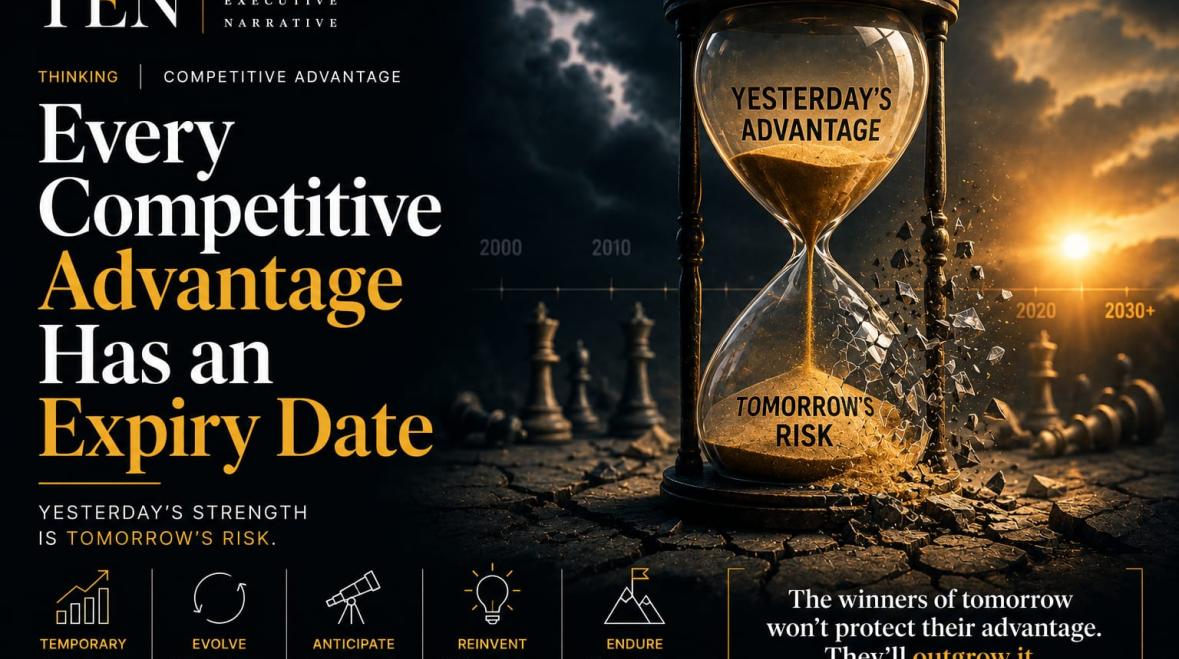
Competitive advantage rarely expires because competitors become stronger. It expires because organisations continue optimising for a market that no longer exists.
Markets evolve faster than organisational beliefs. Companies rarely lose because they forget how to compete. They lose because they become exceptionally good at competing in yesterday's game.
The Success Trap
Organisations naturally invest in what has already proven successful.
A product that dominates the market receives additional funding. A sales model that consistently delivers results becomes the standard. Operational processes are refined, replicated and expanded across the business. Every decision appears rational because it builds upon previous success.
Over time, however, something subtle begins to change. The organisation stops questioning the assumptions that originally created its advantage. Discussions become centred on optimisation rather than exploration. Leaders become increasingly confident that the future will reward the same capabilities that shaped the past.
Success slowly changes from evidence into expectation. The greatest risk is not complacency. It is certainty. When organisations become certain about where value will continue to come from, they often stop noticing where value is beginning to move.
Kodak Didn't Lose to Digital Cameras
Kodak is frequently remembered as the company that failed to embrace digital photography. The reality is more complex. Kodak engineers developed one of the first digital cameras as early as 1975. The organisation understood that digital technology would eventually reshape photography. The challenge was not a lack of awareness. It was the difficulty of redefining a business that had built its identity around film.
For decades, Kodak's competitive advantage was extraordinary. Manufacturing expertise, global distribution and one of the world's strongest consumer brands created a position competitors struggled to match. Those same strengths gradually became strategic constraints. The company continued protecting an advantage that markets were steadily assigning less value to. Kodak did not lose because it lacked innovation. It lost because its existing advantage became more valuable to the organisation than its future advantage.
The Half-Life of Competitive Advantage
Many executives still speak about competitive advantage as though it were a durable asset. Increasingly, it behaves more like a depreciating one. Technology evolves. Customer expectations change. Business models are redefined. New competitors emerge with fundamentally different economics. Each shift quietly reduces the value of advantages that once appeared unassailable.
The pattern becomes visible across industries.
• Operational excellence eventually becomes an industry standard.
• Proprietary technology becomes widely accessible.
• Distribution advantages weaken as digital platforms expand.
• Customer loyalty declines when switching costs fall.
• Scale becomes less valuable when agility creates greater speed.
• Market leadership attracts competitors determined to redefine the rules. The advantage itself rarely disappears overnight. Its relevance slowly declines while organisations continue investing as though nothing has changed.
Reinvention Is the Real Competitive Advantage
The strongest companies understand that competitive advantage is temporary. Their objective is not to defend one advantage indefinitely. It is to build the organisational capability to create the next one before the current one reaches its limits. Amazon repeatedly moved beyond online retail into cloud computing, logistics, artificial intelligence and digital infrastructure. Each expansion reflected more than diversification. It demonstrated a willingness to question whether yesterday's strengths would remain sufficient for tomorrow's market. Reinvention is therefore not an occasional strategic initiative. It is an organisational capability. The companies that endure are rarely those with the strongest competitive advantage. They are the ones that become least emotionally attached to it.
The Hidden Measure of Leadership
Leadership is often evaluated by how effectively it protects existing success. An equally important measure is how willingly it challenges the assumptions behind that success. Every competitive advantage creates habits. Every habit shapes decisions. Every decision gradually reinforces a view of the market that may already be changing. The role of leadership is not simply to strengthen what already works. It is to recognise the moment when protecting yesterday's advantage begins limiting tomorrow's opportunities. That moment rarely announces itself. It appears while performance is still strong. Which is precisely why it is so often ignored.
TEN Perspective
Every board meeting includes discussions about protecting market share. Improving margins. Strengthening customer relationships. Defending competitive position. Those conversations are essential. Perhaps another question deserves equal attention.
Which part of our competitive advantage are we assuming customers will continue to value simply because they valued it yesterday?
Competitive advantage is not permanent. It is borrowed from changing markets. The organisations that endure are not the ones that defend yesterday's edge most successfully. They are the ones that recognise when yesterday's edge has quietly become tomorrow's limitation.
If your greatest competitive advantage disappeared over the next five years, what organisational capability would remain



















Recommended for you
Breaking Down the Elements of a Masterpiece Painting
The Revival of Classical Art in a Digital Age
Must-See Art Exhibitions Around the World This Year
The Revival of Classical Art in a Digital Age