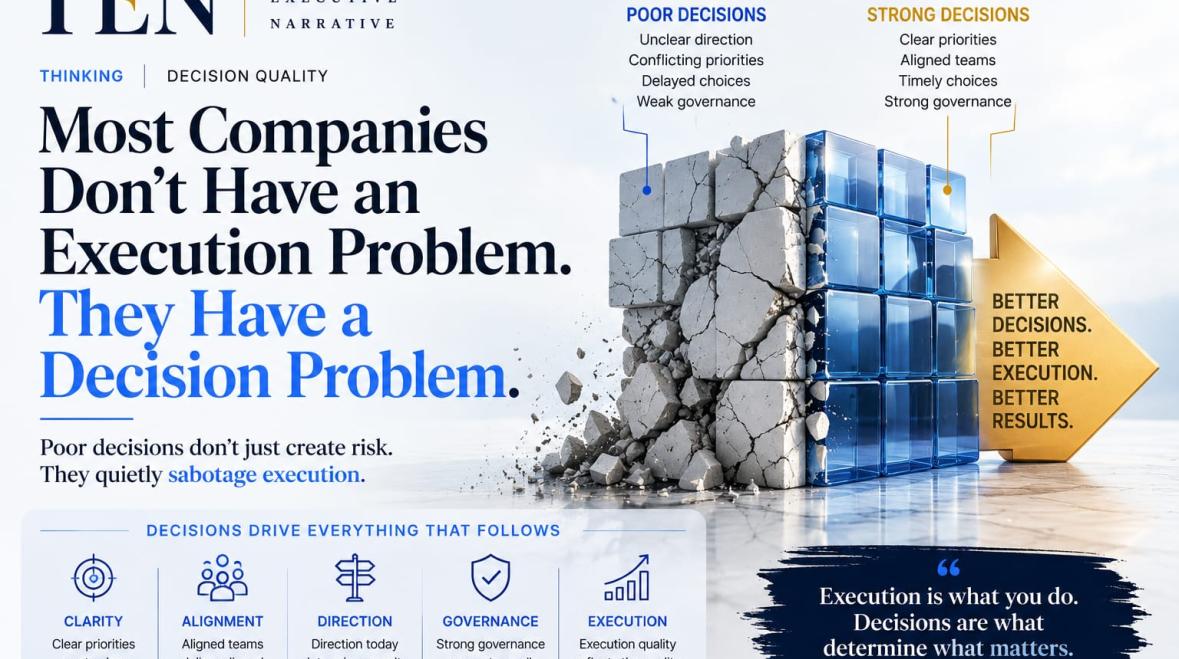
When organisations miss targets, launch products late or struggle to execute strategy, the diagnosis is often predictable. Leaders blame execution. Teams are asked to improve accountability, increase productivity or work with greater urgency. The assumption is that the organisation already knows what needs to be done and simply lacks the discipline to deliver it.Execution certainly matters, but it is rarely where failure begins. In many organisations, poor execution is not the disease. It is the visible symptom of decisions that were unclear, delayed or misaligned long before implementation started.
Execution rarely fails on its own. It usually inherits the quality of the decisions that created it.
The Decision Illusion
Execution is easy to observe. Projects miss deadlines. Costs exceed forecasts. Customers experience delays. Product launches fall behind schedule. These outcomes are visible, measurable and immediate, making execution the obvious place to search for answers. Decisions are different. A poorly framed strategic choice rarely announces itself. An unclear priority, conflicting objective or delayed commitment often appears harmless in the moment. Teams continue working, meetings continue taking place and progress appears steady. Only months later does the organisation discover that people were executing different interpretations of the same strategy. What appears to be an execution problem is often the accumulated cost of decision ambiguity.
Boeing's 737 MAX: When Decisions Shape Outcomes
The challenges surrounding Boeing's 737 MAX were not caused by a sudden breakdown in execution. Thousands of highly skilled engineers, operators and manufacturing teams continued performing their responsibilities. The deeper challenge emerged much earlier, through a series of strategic and organisational decisions. Competitive pressure, programme priorities and governance choices shaped the environment in which later execution took place. Individual decisions that appeared manageable in isolation gradually created conditions where risk accumulated faster than it was recognised.
The lesson extends beyond aviation. Large organisational failures rarely originate from one catastrophic decision. They emerge when multiple reasonable decisions begin reinforcing one another without sufficient challenge or review. By the time execution appears to fail, the organisation is often operating within constraints created months—or even years—earlier.
How Decision Quality Compounds
Every executive decision influences the decisions that follow. A vague strategic priority produces competing interpretations. Competing interpretations create conflicting departmental goals. Conflicting goals generate duplicated work, slower approvals and unnecessary coordination. Eventually, teams appear to execute poorly when they are simply responding to inconsistent direction.
The pattern is remarkably consistent.
•Unclear priorities create fragmented execution.
•Delayed decisions increase organisational uncertainty.
•Conflicting objectives encourage departments to optimise for different outcomes.
•Frequent changes in direction reduce confidence and slow momentum.
•Weak governance allows small decision errors to compound into operational failures. Execution reflects the cumulative quality of hundreds of earlier decisions, not just the effort of the teams responsible for delivery.
Decision Quality Is a Strategic Capability
High-performing organisations do not succeed because they avoid mistakes. They succeed because they improve the quality of decisions before execution begins. This requires more than faster decision-making. It requires clear priorities, well-defined ownership and disciplined governance that enables difficult choices to be challenged before they become organisational commitments.
Amazon's leadership principles illustrate this distinction. The concept of distinguishing between reversible and irreversible decisions encourages leaders to match decision speed with decision risk. Rather than treating every choice with equal weight, the organisation recognises that better decision quality improves execution long before projects reach customers. Execution becomes faster because the organisation spends less time correcting decisions that should have been resolved earlier.
Execution Is the Final Chapter, Not the First
Organisations often review execution after projects finish. They analyse delivery timelines, operational efficiency and financial outcomes. Those reviews are valuable, but they frequently begin too late. The more revealing question is not how well the organisation executed. It is whether execution ever had a realistic chance of succeeding given the decisions that shaped it. Leadership is ultimately responsible for creating the conditions in which execution becomes possible. Teams execute. Leaders determine what is worth executing. The quality of that judgment defines the quality of organisational performance.
TEN Perspective
Every executive dashboard measures execution. Revenue. Margins. Delivery timelines. Customer satisfaction. Operational performance. Perhaps leadership should measure something less visible. The quality of the decisions that produced those outcomes. Execution is where organisations experience success or failure. Decision-making is where both are created. Before asking why a project failed to deliver its objectives, pause and ask a more difficult question. If every execution failure in your organisation could be traced back to one earlier decision, which decision would appear most often?





















Recommended for you
Breaking Down the Elements of a Masterpiece Painting
The Revival of Classical Art in a Digital Age
Must-See Art Exhibitions Around the World This Year
The Revival of Classical Art in a Digital Age