
The Fastest Learner Usually Wins the Market
August 08, 2026
- 5 mins read







2026 Copyright @ TEN.
All Rights Reserved
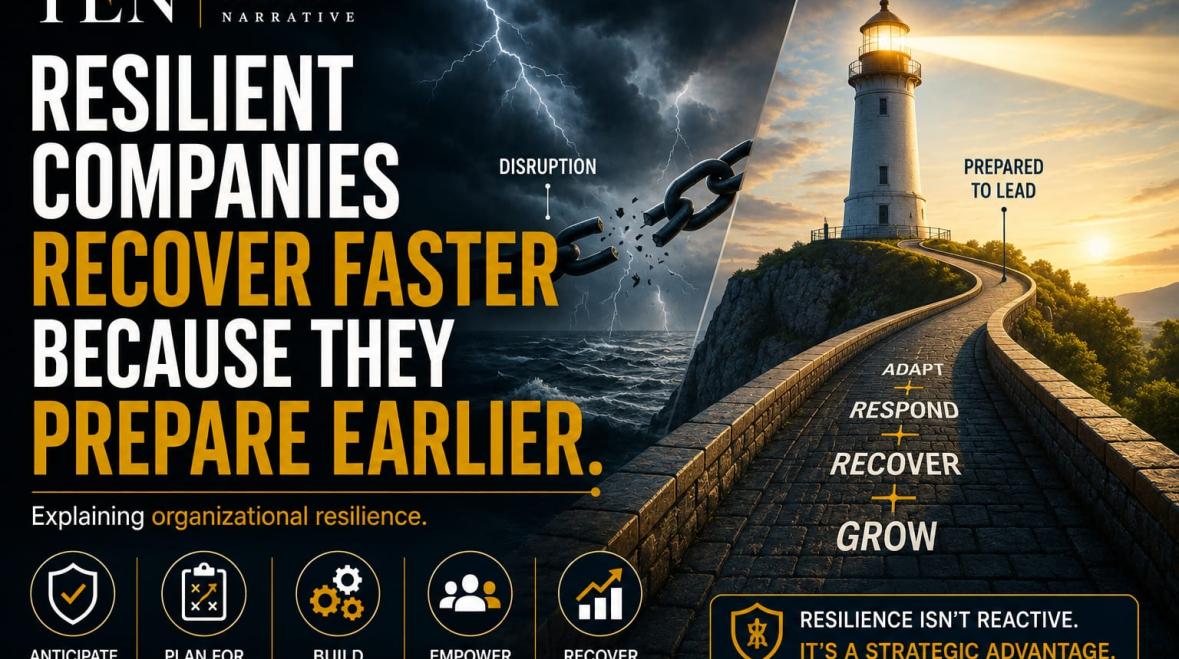
Resilience Is Built Before the Crisis
Resilience is often measured by what happens after something goes wrong. How quickly did the company recover? How much revenue was protected? How effectively did leadership respond?
But recovery is rarely determined only when the crisis arrives.The organizations that recover fastest have usually been preparing long before they need to. They have tested their assumptions, built flexibility into their operations, developed alternative options and identified where a disruption could create the greatest damage.
Resilience is not the ability to avoid disruption. It is the ability to absorb it without losing strategic direction.
Preparation Creates Options
When disruption occurs, unprepared companies often have to make decisions under pressure. Suppliers may be unavailable, systems may fail, customers may change their behavior or critical employees may suddenly become unavailable.
Every decision becomes urgent.
Resilient organizations have more options because they have already considered what could go wrong. They may have alternative suppliers, flexible processes, distributed capabilities or clear contingency plans. More importantly, leadership has already discussed how the organization would respond.
Preparation does not eliminate uncertainty.
It reduces the number of decisions that must be invented during the crisis.
Resilience Is More Than a Backup Plan
A backup plan is useful, but organizational resilience goes deeper.
It is reflected in how a company is designed. A highly centralized operation may be efficient during stable conditions but vulnerable when one point of failure is disrupted. A company dependent on a single supplier may have excellent margins until that supplier becomes unavailable. A team built around one critical individual may perform exceptionally until that person leaves.
Efficiency often focuses on maximizing performance under expected conditions.
Resilience asks a different question: What happens when conditions are no longer expected?
The strongest organizations understand that some redundancy, flexibility and optionality may appear inefficient in the short term but become extremely valuable when circumstances change.
The Hidden Value of Scenario Thinking
Leaders cannot predict every crisis. They can, however, think through categories of disruption.
What happens if demand suddenly falls? What happens if it doubles? What if a critical supplier disappears? What if technology changes the economics of the industry? What if a key capability becomes unavailable?
Scenario thinking forces leadership to examine weaknesses while there is still time to address them.It also exposes dependencies that normal operating conditions can hide.The goal is not to create a plan for every imaginable event. It is to understand which assumptions the organization is most dependent on and where a failure would have the greatest consequences.
The Executive Responsibility
Resilience begins with leadership's willingness to prepare for uncomfortable possibilities before they become immediate problems. Leaders need to identify critical dependencies, understand where the organization has limited flexibility and invest in capabilities that allow the business to adapt when conditions change. This may involve maintaining alternative suppliers, developing multiple sources of expertise, testing continuity plans or creating financial and operational buffers. The objective is not to make the organization immune to disruption. It is to ensure that when disruption arrives, the company still has enough options to make deliberate decisions instead of being forced into reactive ones.
Recovery Speed Is a Strategic Advantage
Two companies can experience the same disruption and have completely different outcomes.
One spends weeks figuring out what to do because every decision is being made for the first time. The other activates capabilities it has already tested, moves resources quickly and focuses on restoring the most critical parts of the business.
The difference is preparation.
This is why resilience should not be viewed only as an insurance expense. It can become a competitive advantage. Companies that recover faster can regain customer confidence sooner, protect valuable talent and return to growth while slower competitors are still rebuilding.
Resilience therefore affects more than survival.
It affects how quickly a company can return to creating value.
Executive Lessons
Organizational resilience comes from designing the business to function under changing conditions, not simply from reacting well after disruption occurs. Leaders should identify critical dependencies, build appropriate flexibility, test important assumptions and preserve enough resources and options to respond when circumstances change. The goal is not to eliminate every possible risk. It is to ensure that one unexpected event does not remove the organization's ability to choose its next move.
TEN Perspective
Resilient companies are not necessarily the companies that experience fewer disruptions.They are the companies that have fewer surprises when disruptions happen.Preparation gives leadership something extremely valuable during uncertainty: options.
The question is therefore not simply:
“How quickly can we recover if something goes wrong?”
It is:
“What can we prepare today so that recovery becomes easier tomorrow?”
Because resilience is rarely created in the moment of crisis.
It is built quietly, long before the crisis arrives.











Recommended for you
Breaking Down the Elements of a Masterpiece Painting
The Revival of Classical Art in a Digital Age
Must-See Art Exhibitions Around the World This Year
The Revival of Classical Art in a Digital Age